
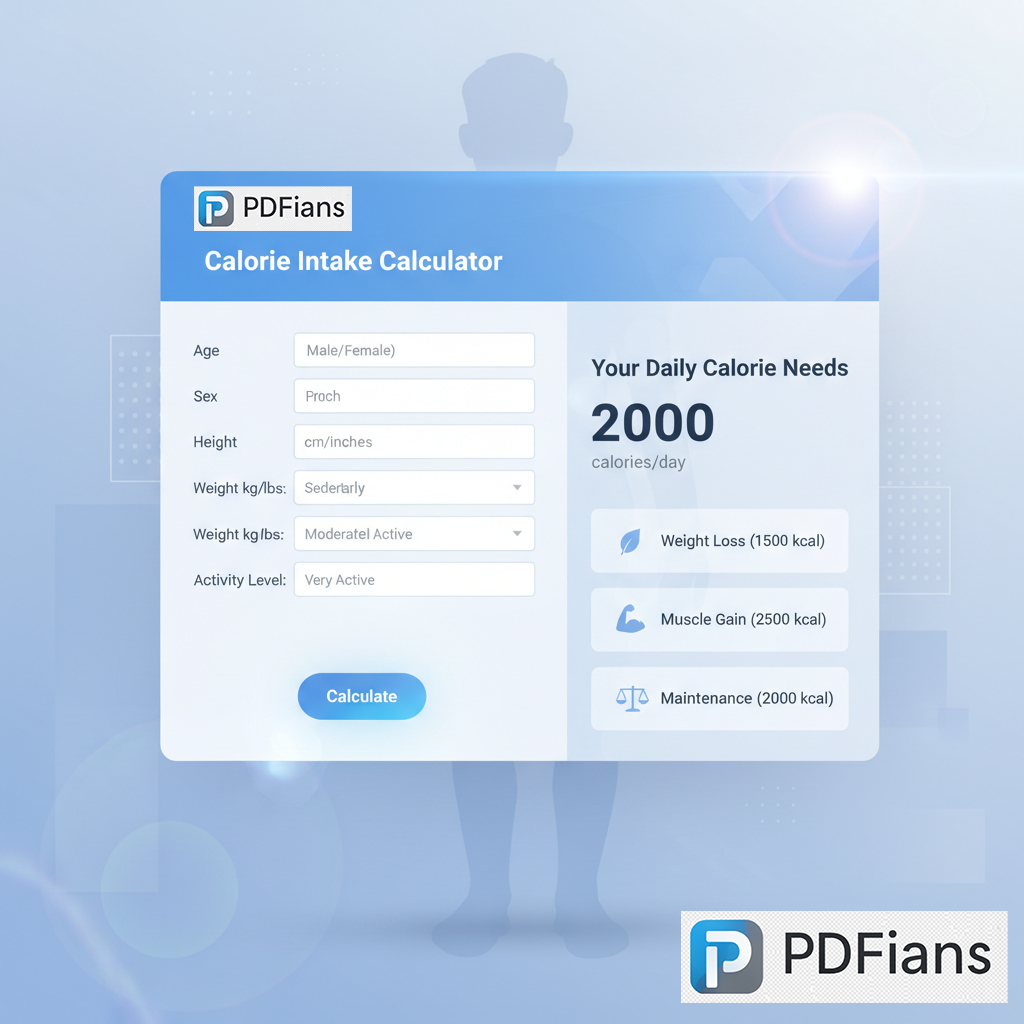
Calorie Intake Calculator
Calculate your daily calorie needs based on your personal goals
Your Information
Your Results
Your results will appear here after calculation. Enter your information and click "Calculate Calories".
Maintenance Calories
These are the calories you need to maintain your current weight.
Recommended Intake
These are the calories recommended for your goal.
Macronutrient Breakdown
Based on a balanced ratio of 30% protein, 50% carbs, and 20% fat.
Body Mass Index (BMI)
Healthy Eating Tips
Eat Whole Foods
Focus on unprocessed foods like fruits, vegetables, lean proteins, and whole grains.
Stay Hydrated
Drink plenty of water throughout the day to support metabolism and reduce cravings.
Portion Control
Be mindful of portion sizes even when eating healthy foods.
Regular Meals
Eat at regular intervals to maintain energy levels and prevent overeating.
This tool is provided by PDFians.com - your source for PDF tools and resources.
Note: This calculator provides estimates only. For personalized nutrition advice, consult a healthcare professional.
Unlock Your Health Potential with the Calorie Intake Calculator
Understanding your daily calorie intake is fundamental to achieving any health or fitness goal. Whether you aim to lose weight, gain muscle, or maintain your current physique, knowing your caloric needs provides a powerful roadmap. Fortunately, tools like the Calorie Intake Calculator by PDFians make this process incredibly simple and accurate. This comprehensive guide will delve into the importance of calorie tracking, how our calculator works, and practical tips for incorporating this knowledge into your lifestyle.
Why Your Daily Calorie Intake Matters
Calories, essentially units of energy, fuel every function your body performs – from breathing and thinking to exercising and digesting. Your total daily energy expenditure (TDEE) represents the number of calories you burn each day. This figure is influenced by several factors, including your basal metabolic rate (BMR), physical activity level, and the thermic effect of food. Ignoring your specific calorie intake requirements can hinder progress. For example, consuming too many calories leads to weight gain, while too few can result in fatigue, nutrient deficiencies, and muscle loss. Therefore, a precise understanding of your needs is the cornerstone of effective health management.
Understanding Basal Metabolic Rate (BMR)
Your Basal Metabolic Rate (BMR) signifies the number of calories your body burns at rest to maintain vital functions. Think of it as the minimum energy required to keep you alive. Factors such as age, sex, weight, height, and genetics all play a significant role in determining your BMR. For instance, individuals with more muscle mass generally have a higher BMR because muscle tissue burns more calories than fat, even at rest. Our Calorie Intake Calculator takes these variables into account to provide an accurate BMR estimation, forming the foundation of your personalized calorie recommendation.
How the PDFians Calorie Intake Calculator Works
The PDFians Calorie Intake Calculator simplifies the complex science of nutrition into an easy-to-use tool. Utilizing established formulas like the Mifflin-St Jeor equation, our calculator asks for a few key pieces of information: your age, sex, weight, height, and activity level. Subsequently, it computes your BMR and then adjusts it based on your reported activity level to estimate your TDEE. This TDEE is your starting point for determining your ideal daily calorie intake. Furthermore, the calculator can suggest calorie targets for different goals, whether it’s weight loss, maintenance, or muscle gain, providing clear, actionable insights.
Inputs for Accurate Calorie Calculation
To ensure the most precise calorie intake estimate, the PDFians tool requires accurate input. Firstly, enter your current weight and height. Secondly, specify your age and sex, as these biological factors significantly impact metabolic rate. Finally, select your typical activity level from the provided options, ranging from sedentary to very active. Being honest about your activity level is crucial, as underestimating or overestimating can lead to an inaccurate TDEE. A common pitfall is to overstate activity, leading to higher suggested calorie targets which might impede weight loss efforts. Our intuitive interface makes entering this data straightforward.
Setting Your Health Goals: Weight Loss, Gain, or Maintenance
Once you have your estimated TDEE from the Calorie Intake Calculator, you can then tailor your daily calorie intake to match your specific health objectives.
If your goal is weight loss, you will need to create a calorie deficit, meaning you consume fewer calories than you burn. A deficit of 500 calories per day typically leads to a loss of about one pound per week, a sustainable and healthy rate. Conversely, for weight gain, particularly muscle mass, a calorie surplus is necessary. This involves consuming more calories than your TDEE. Lastly, if you are aiming for weight maintenance, your calorie intake should closely match your TDEE. Our calculator provides personalized recommendations for each of these scenarios, helping you make informed dietary choices.
Achieving Sustainable Weight Loss
For individuals focusing on weight loss, a gradual and consistent approach is always recommended. Drastic calorie restriction can be counterproductive, potentially slowing down your metabolism and leading to nutrient deficiencies. Instead, our Calorie Intake Calculator helps you identify a moderate deficit that promotes steady weight reduction without sacrificing essential nutrients. Moreover, combining a controlled calorie intake with regular physical activity can significantly enhance results. Remember, healthy weight loss is a marathon, not a sprint, requiring patience and consistency. Consider integrating more whole foods into your diet, which are typically lower in calories but higher in nutrients.
Beyond Calories: The Importance of Macronutrients
While understanding your calorie intake is vital, it’s also crucial to consider the source of those calories. Macronutrients – carbohydrates, proteins, and fats – each play distinct roles in your body and contribute to your overall health. For instance, protein is essential for muscle repair and growth, while carbohydrates provide immediate energy. Healthy fats are necessary for hormone production and nutrient absorption. Our Calorie Intake Calculator primarily focuses on the total calorie number, but for advanced users, tracking macros within that calorie budget can further optimize results. Many online resources and apps can help you manage your macro splits once you have your target calorie intake.
Frequently Asked Questions about Calorie Intake
Q1: How accurate is the Calorie Intake Calculator?
A1: Our Calorie Intake Calculator uses well-established scientific formulas to provide a highly accurate estimation of your daily caloric needs. However, individual metabolism can vary, so it serves as an excellent starting point. Adjustments may be necessary based on your personal progress and how your body responds.
Q2: Can children use the Calorie Intake Calculator?
A2: The PDFians Calorie Intake Calculator is designed for adults. Calorie needs for children and adolescents are different and should be determined by a healthcare professional or a registered dietitian, as their growth and development require specific nutritional considerations.
Q3: What if my activity level changes frequently?
A3: If your activity level fluctuates, it’s best to use an average estimate for the week or recalculate your needs on highly active days. The Calorie Intake Calculator is flexible, allowing you to re-evaluate your needs as your lifestyle evolves. Consistent monitoring helps in making necessary adjustments.
Q4: Is calorie counting essential for everyone?
A4: While not everyone needs to count calories meticulously, understanding your approximate daily calorie intake is beneficial for most people, especially those with specific health or fitness goals. It raises awareness about food choices and portion sizes, empowering healthier eating habits.
Q5: Where can I find healthy recipes within my calorie budget?
A5: Numerous online platforms and cookbooks offer healthy recipes tailored to various calorie targets. Websites focusing on nutrition and fitness often provide meal plans and recipe ideas. Once you determine your ideal calorie intake with our tool, searching for “healthy recipes for [your calorie target]” can yield excellent results.
Q6: How often should I use the Calorie Intake Calculator?
A6: It is a good practice to revisit the Calorie Intake Calculator every few weeks or whenever you experience significant changes in weight, activity level, or health goals. Regular recalculations ensure your target calorie intake remains relevant to your current physiological state and objectives. This proactive approach supports continuous progress and adaptation.
Pro Tips for Effective Calorie Management
Managing your calorie intake effectively extends beyond just knowing a number; it involves integrating that knowledge into your daily life. Firstly, consider meal prepping. Preparing meals in advance helps you control portion sizes and ingredients, making it easier to stick to your calorie goals. Secondly, pay attention to food labels. Understanding the caloric content and nutritional information of packaged foods empowers you to make smarter choices. Thirdly, stay hydrated! Often, thirst is mistaken for hunger, leading to unnecessary snacking. Drinking plenty of water can help manage appetite and contributes to overall health. Furthermore, remember that consistency is key; occasional deviations are normal, but returning to your plan promptly ensures long-term success.