
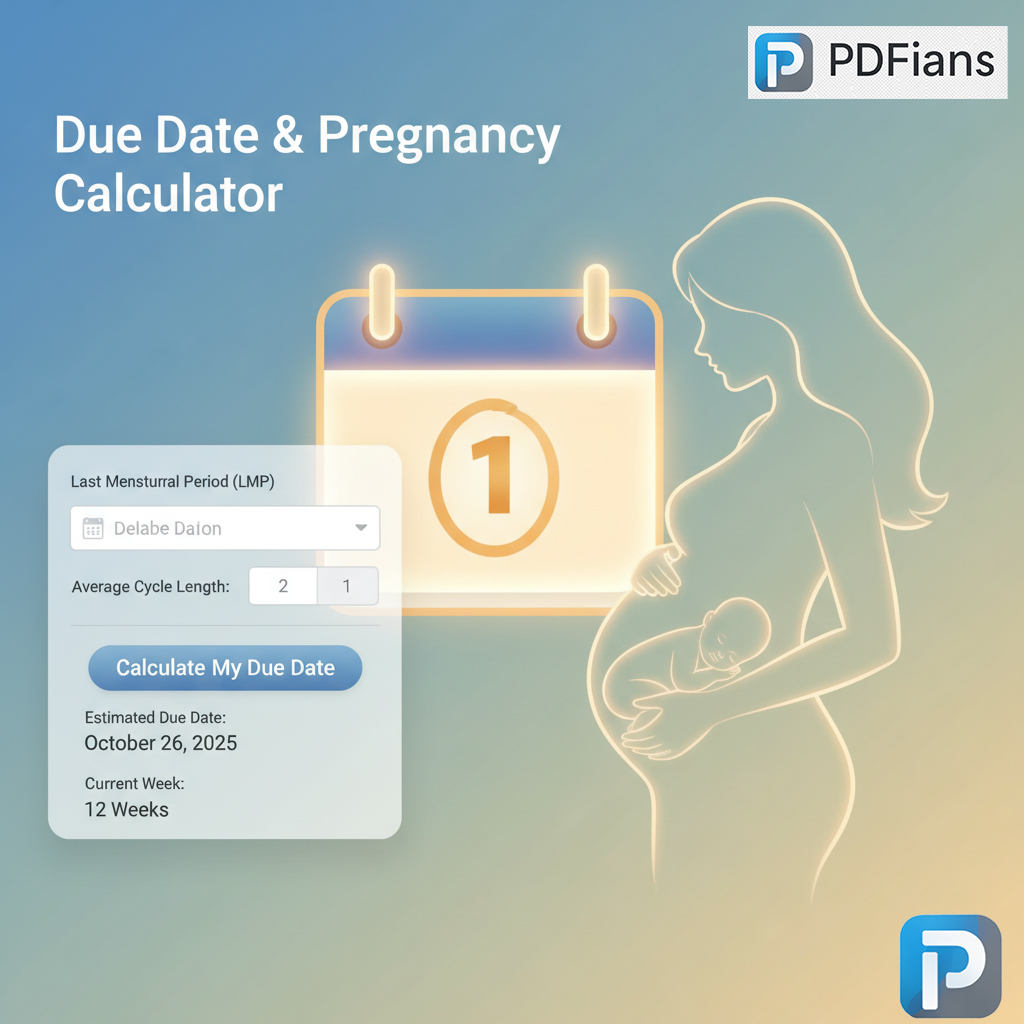
Due Date & Pregnancy Calculator
Calculate your due date and track your pregnancy progress
Pregnancy Details
Pregnancy Summary
Pregnancy Timeline
First Trimester
Weeks 1-13
Early development, major organs begin to form.
Second Trimester
Weeks 14-27
Baby grows rapidly, you may feel movement.
Third Trimester
Weeks 28-40
Final growth phase, baby prepares for birth.
Weekly Development
| Week | Size | Development |
|---|
About Due Date Calculation
Due date calculation is typically based on Naegele's rule, which estimates the expected date of delivery (EDD) by adding 280 days (40 weeks) to the first day of the last menstrual period (LMP).
The formula for Naegele's rule is:
EDD = LMP + 280 days
This calculation assumes a 28-day menstrual cycle with ovulation occurring on day 14. For women with longer or shorter cycles, the due date can be adjusted:
Adjusted EDD = LMP + 280 days + (cycle length - 28 days)
If the conception date is known, the due date can be calculated by adding 266 days (38 weeks) to the conception date, as pregnancy is typically 38 weeks from conception.
It's important to remember that only about 5% of babies are born on their exact due date. Most births occur within two weeks before or after the estimated due date.
This calculator provides an estimate based on standard obstetric calculations. Always consult with your healthcare provider for personalized medical advice.
Due Date & Pregnancy Calculator-PDFians
When Your Baby is Due?
Discovering you’re pregnant marks the beginning of an incredible journey, filled with anticipation, joy, and countless questions. Among the most pressing is “When is my baby due?” Understanding your estimated due date is crucial for planning, preparing, and tracking your pregnancy milestones. Fortunately, the PDFians Due Date & Pregnancy Calculator is here to simplify this exciting time. This comprehensive guide will walk you through everything you need to know about calculating your due date, understanding pregnancy stages, and utilizing our invaluable tool.
Understanding Your Due Date: More Than Just a Number
The due date, or estimated date of delivery (EDD), is a projection of when your baby is likely to arrive. While only about 4% of babies are born exactly on their due date, it serves as a vital benchmark for medical professionals and expectant parents alike. Knowing your due date helps doctors monitor your baby’s growth and development, schedule important prenatal appointments, and plan for delivery. Furthermore, it empowers you to organize your life around the arrival of your little one, from setting up the nursery to attending prenatal classes.
How Our Pregnancy Calculator Works
Our Due Date & Pregnancy Calculator utilizes a widely accepted method to estimate your baby’s arrival. Typically, pregnancy is considered to last around 40 weeks (280 days) from the first day of your last menstrual period (LMP). However, not everyone remembers their LMP precisely, or cycles can be irregular. Therefore, our tool considers several factors to provide an accurate estimate. By inputting key information, you receive a reliable due date, allowing you to move forward with confidence.
The Science Behind Pregnancy Weeks
It’s fascinating to realize that pregnancy is usually counted from the first day of your last period, even though conception occurs later, around two weeks into your cycle. This standard method helps to provide a consistent timeline for everyone. Throughout these 40 weeks, your baby undergoes remarkable transformations, growing from a tiny cluster of cells into a fully developed infant. Each week brings new developments and exciting changes for both you and your baby.
Tracking Your Pregnancy Milestones with Ease
Knowing your due date is just the first step; tracking your pregnancy milestones is equally important. From the first flutter of movement to the final weeks of preparation, each stage holds unique significance. Our Due Date & Pregnancy Calculator not only provides your EDD but also helps you visualize the timeline of your pregnancy, month by month. Consequently, you can anticipate key developments and prepare accordingly.
First Trimester: The Foundation of Life
The first trimester (weeks 1-13) is a period of rapid development for your baby. Critical organs begin to form, and you might experience early pregnancy symptoms such as morning sickness and fatigue. This is also when your first prenatal appointments are scheduled, including confirming your pregnancy and discussing your health history. It is generally a time of significant adjustment as your body begins to nurture a new life. For more detailed information, consider exploring resources like the American College of Obstetricians and Gynecologists (ACOG).
Second Trimester: The Golden Period
Often referred to as the “golden period,” the second trimester (weeks 14-27) typically brings a resurgence of energy and a decrease in some early pregnancy symptoms. You might start to feel your baby move, and exciting ultrasound scans will reveal more about your baby’s growth. This is a wonderful time to start planning for your baby’s arrival, attending childbirth classes, and connecting with other expectant parents. Furthermore, many parents choose to reveal their pregnancy during this period as the risk of miscarriage significantly decreases.
Third Trimester: Preparing for Arrival
The third trimester (weeks 28-40) is all about preparation. Your baby is growing rapidly, gaining weight, and perfecting their movements. You might experience some discomfort as your body prepares for labor, but the excitement of meeting your little one will surely outweigh any challenges. Prenatal appointments become more frequent, focusing on monitoring your baby’s position and your overall health. It is generally advisable to have your hospital bag packed and your birth plan finalized during this stage.
Why Choose the PDFians Due Date & Pregnancy Calculator?
At PDFians, we understand the importance of reliable information during such a significant time. Our Due Date & Pregnancy Calculator is designed to be user-friendly, accurate, and readily accessible. We strive to provide tools that simplify life’s complex moments, and pregnancy is no exception. Because of this commitment, we ensure our calculator offers clear, concise results that empower you throughout your journey.
Accuracy and Simplicity Combined
The primary advantage of our tool is its seamless blend of accuracy and simplicity. You don’t need to be a medical expert to use it. Simply input the required information, and our calculator will do the rest, providing you with a reliable estimated due date. Therefore, you can spend less time calculating and more time savoring your pregnancy.
Accessible Anytime, Anywhere
Our online Due Date & Pregnancy Calculator is available 24/7, from any device with an internet connection. Whether you’re at home, at work, or on the go, you can easily access our tool whenever you need it. This convenience ensures that valuable information is always at your fingertips, allowing you to stay informed and prepared.
A Part of Your Pregnancy Toolkit
Consider our calculator an essential part of your comprehensive pregnancy toolkit. Alongside your doctor’s advice and other trusted resources, it provides a practical way to keep track of your progress. It effectively complements other PDFians tools, allowing you to organize documents and information related to your pregnancy journey.
Frequently Asked Questions About Due Dates and Pregnancy
Many questions arise during pregnancy, and having reliable answers can provide immense peace of mind. Here are some commonly asked questions related to due dates and pregnancy.
Q1: How accurate is a due date?
A1: Due dates are estimates. While they provide a good guideline, only about 4% of babies are born exactly on their due date. Most babies arrive within two weeks before or after their estimated due date. Therefore, it’s essential to remember it’s a window, not a hard deadline.
Q2: What if I don’t remember my last menstrual period (LMP)?
A2: If you don’t remember your LMP, don’t worry! Your doctor can use an early ultrasound to estimate your due date. Ultrasound measurements of your baby in the first trimester are generally very accurate in determining gestational age.
Q3: Can my due date change?
A3: Yes, your due date can sometimes be adjusted. If an early ultrasound reveals a significant discrepancy from the due date calculated by your LMP, your doctor might adjust it. However, once a due date is established based on a first-trimester ultrasound, it typically remains fixed.
Q4: What are the main methods to calculate a due date?
A4: The most common methods are Naegele’s Rule (based on your LMP) and early ultrasound scans. Naegele’s Rule adds 7 days to the first day of your LMP, then subtracts 3 months, and adds 1 year. This is the basis for many online calculators, including the PDFians Due Date & Pregnancy Calculator.
Q5: What is the significance of “full term”?
A5: “Full term” generally refers to a pregnancy lasting between 39 weeks 0 days and 40 weeks 6 days. Babies born within this period have the best health outcomes. “Early term” is 37 weeks 0 days to 38 weeks 6 days, and “late term” is 41 weeks 0 days to 41 weeks 6 days.
Q6: How many trimesters are there in pregnancy?
A6: Pregnancy is divided into three trimesters, each lasting approximately three months. The first trimester is weeks 1-13, the second is weeks 14-27, and the third is weeks 28-40 (or until delivery).
Q7: Where can I find more resources on pregnancy?
A7: Numerous reputable organizations offer valuable pregnancy resources. For instance, the Mayo Clinic provides extensive information on all aspects of pregnancy and childbirth. Additionally, local hospitals and birthing centers often host educational classes and support groups.
Conclusion: Your Partner in Pregnancy Planning
The journey of pregnancy is a wondrous adventure, and having the right tools can make it even more enjoyable. The PDFians Due Date & Pregnancy Calculator is designed to be a reliable and user-friendly companion, providing you with essential information as you embark on this exciting chapter. From the initial calculation of your due date to tracking key milestones, we are here to support you every step of the way. Ultimately, our goal is to empower you with knowledge and peace of mind as you prepare to welcome your new addition.